
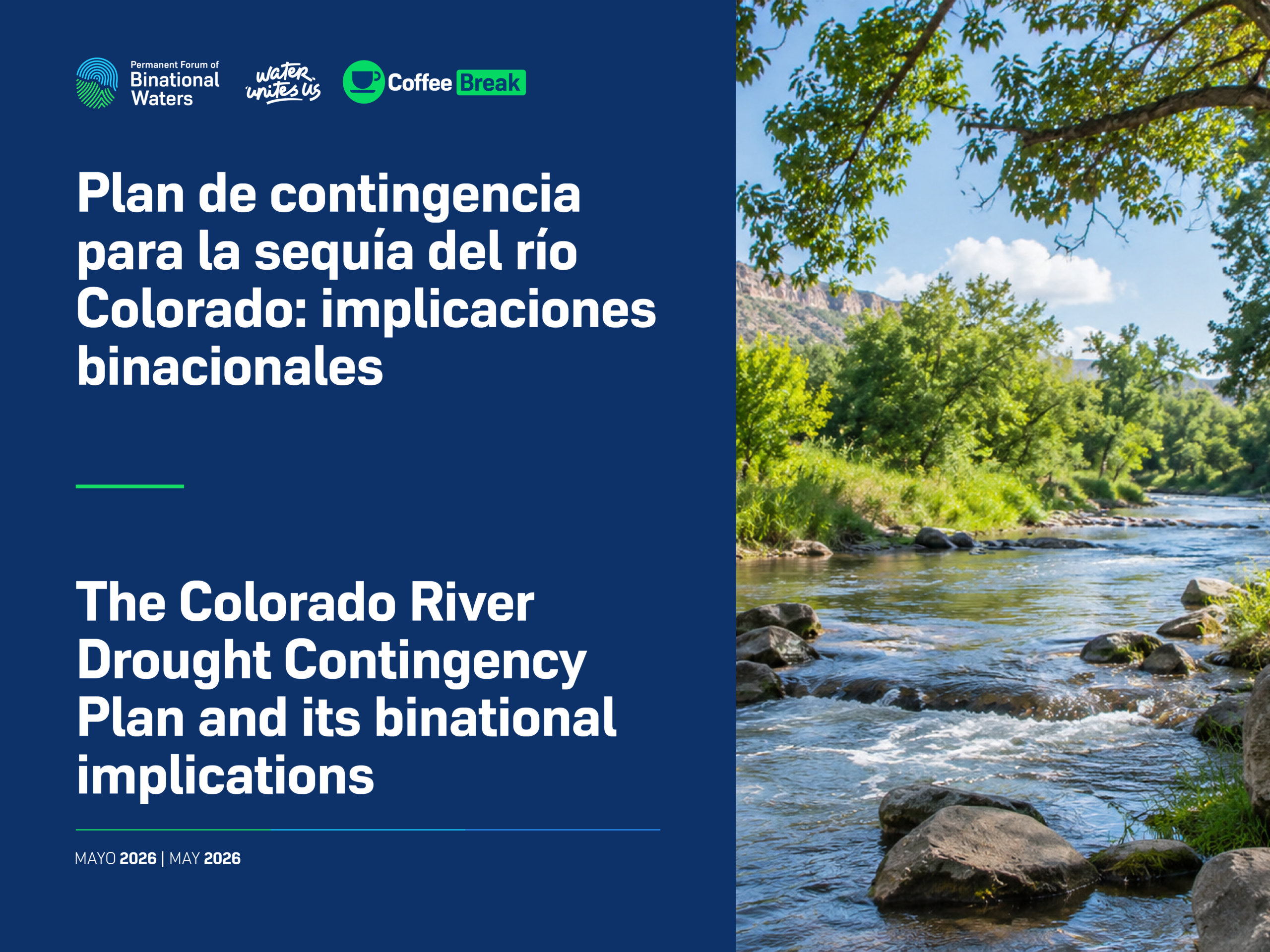
The Colorado River Basin faces growing challenges as declining water availability, increasing pressure on water resources, and prolonged political negotiations complicate the development of a long-term management framework. With the 2019 Drought Contingency Plan and the 2007 Interim Guidelines scheduled to expire at the end of 2026, the development of new operating guidelines represents a critical opportunity to address structural water imbalances and strengthen cooperation between Mexico and the United States.
Para apoyar el intercambio de conocimientos sobre este tema, el Foro Permanente de Aguas Binacionales (PFBW) preparó un informe del evento basado en el Coffee Break El Plan de Contingencia para la Sequía del Río Colorado y sus Implicaciones Binacionales, held on May 7, 2026. The document synthesizes the principal insights presented by Jack Schmidt, Gina Gilson, and Mike Zellner during a discussion moderated by Rosario Sanchez.
One of the central issues examined in the brief is the convergence of political and hydrological crises. At the time of the discussion, Colorado’s snowpack had reached approximately 25 percent of normal levels, while projections indicated that Lake Powell could fall below its minimum power pool elevation. These conditions, combined with delays in negotiations among basin states, highlight the challenges of developing operating guidelines that will replace the existing contingency plan.
The brief also examines the structural imbalance between water availability and consumptive use, which stands at approximately 12.5 million acre-feet across the basin. Around 55 percent of basin water is used to produce livestock feed, particularly alfalfa and grass hay. These figures underscore the importance of addressing agricultural water consumption, supporting locally led demand-management programs, and recognizing the limitations of urban water conservation alone.
Another important section focuses on binational cooperation under the 1944 Water Treaty
Mexico’s participation in the 2019 contingency plan demonstrates the capacity of both countries to adapt to changing hydrological conditions through the Treaty’s Minute process. The discussion also examines proposed reductions in Mexico’s water allocation and alternative approaches that could establish allocations based on natural river flows rather than fixed volumes.
The brief concludes by highlighting the importance of enforceable water-use reductions, stronger binational cooperation, continued investment in the restoration of the Colorado River Delta, and broader public participation in water governance. Readers are invited to consult or download the complete PDF prepared by the PFBW to explore the full synthesis and its implications for the future of Colorado River Basin management.
Respuestas