
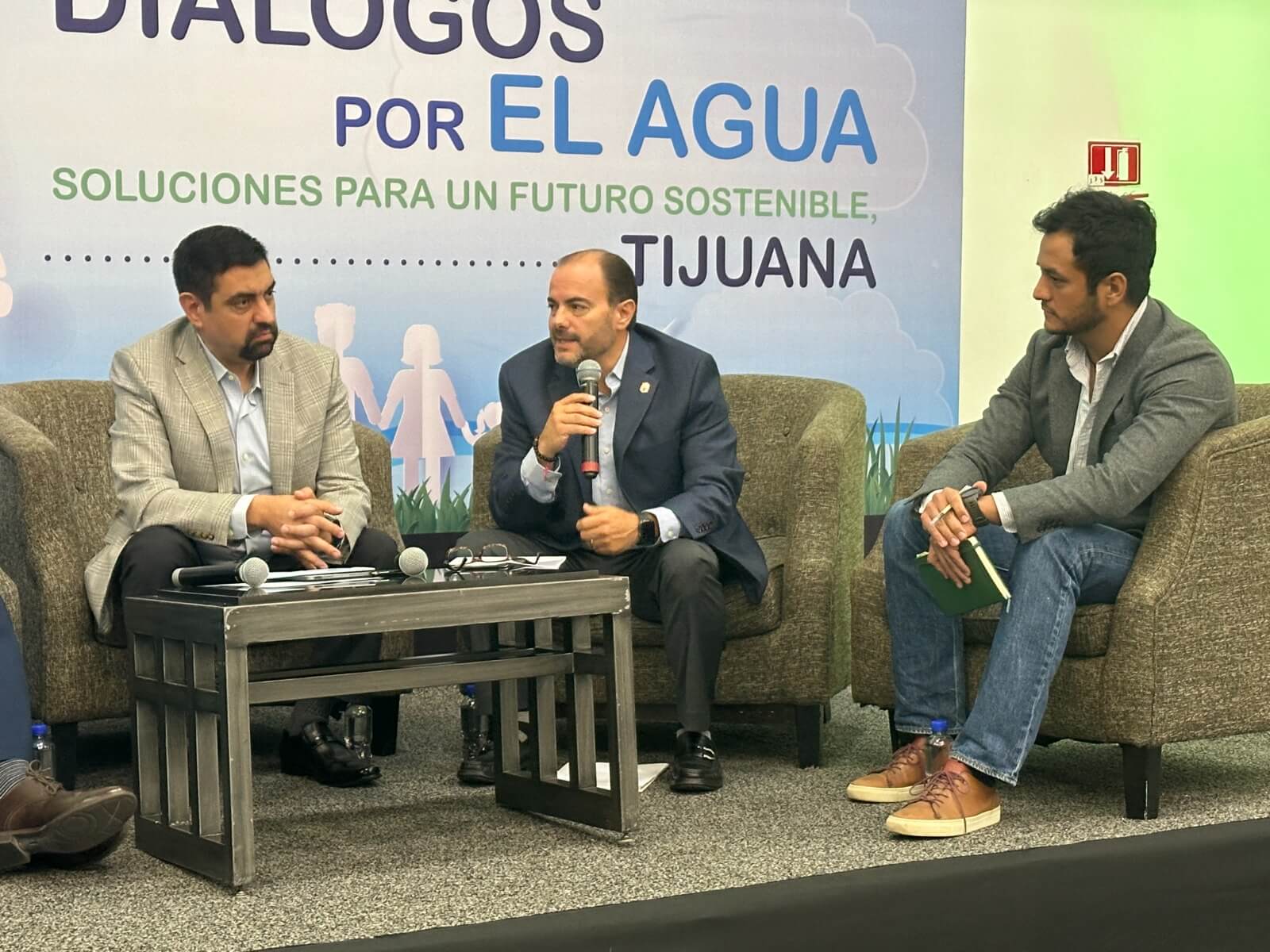
Erick Velázquez, the project coordinator for the Tijuana River Basin at PFBW, believes that there is a water crisis between Mexico and the United States, caused by various factors including governance.
Erick Velázquez Hernández, the Project Coordinator in the Tijuana River Basin for the Permanent Forum of Binational Waters (PFBW), participated in the event “Dialogues for Water: Solutions for a Sustainable Future,” held this month at the Gran Hotel Tijuana.
The event, organized by the State Commission of Public Services of Tijuana (CESPT), the National Association of Water and Sanitation Companies (ANEAS), and the Water Advisory Council, brought together experts and leaders in water management to address critical issues affecting the region.
During his participation, Erick Velázquez, a specialist in water governance, emphasized that effective governance is central to addressing the current water crisis between Mexico and the United States. He described water governance as a complex interplay of political, social, economic, and administrative systems essential for managing and allocating water resources and services. This, he noted, is fundamental for achieving sustainable development across the border region.
He explained that governance in water is inherently multi-level, involving decision-making from local to international scales and across sectors such as agriculture, urban supply, and ecosystems. He echoed international frameworks, such as those of the OECD, in asserting that many water crises are essentially crises of governance.
A crucial point raised by Velázquez was the importance of binational cooperation—not only through high-level agreements but also through inclusive, ground-up collaboration. He also stressed the lack of reliable data on volumes, flows, and water quality in border basins, which is vital for any strategy aimed at sustainable development.
Furthermore, he emphasized the need to embed sustainable development principles into everyday decision-making across water-intensive industries, including better understanding of the water footprint of exported products and services.
The forum concluded with discussions on investment, long-term planning, and public engagement as key pillars of sustainable development in water management, highlighting successful regional models and calling for greater transparency and citizen involvement.
Responses