
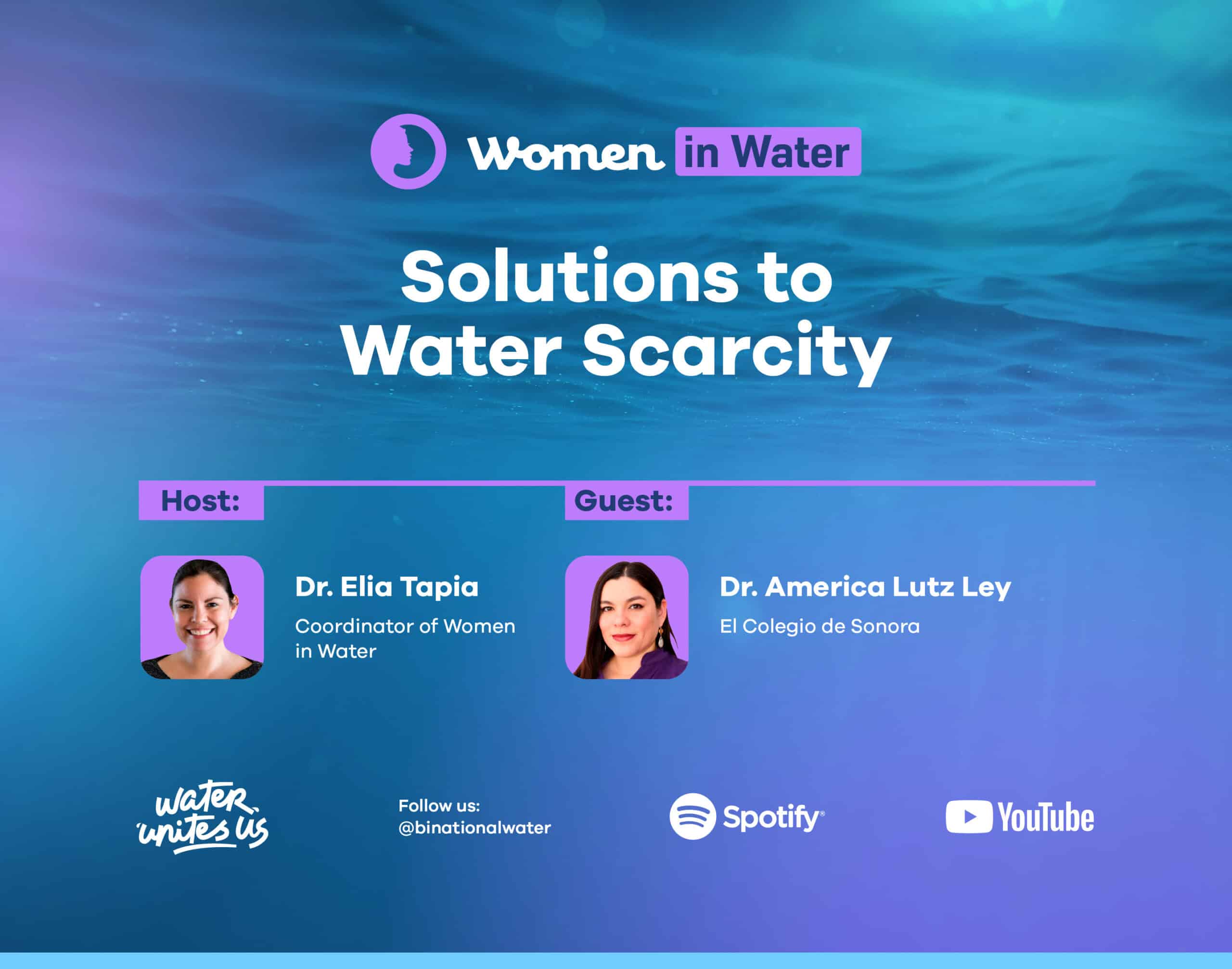
This interview is part of the Women in Water initiative, hosted by Dr. Elia Tapia, which highlights the voices and contributions of women working in water, sustainability, and environmental fields across the U.S.–Mexico border. In Episode 5, Dr. Elia Tapia welcomes Dr. America Lutz Ley, Academic Director and Research Professor at El Colegio de Sonora, to discuss the complex challenges surrounding water security, climate change, environmental justice, and the need for solutions to water scarcity.
Originally trained as a psychologist, Dr. Lutz Ley developed an interest in environmental behavior before transitioning into water governance and arid land resource science. Her interdisciplinary background has allowed her to study how climate change, water governance, mining, and socio-ecological systems intersect throughout the Sonora–Arizona border region. Her work demonstrates that addressing water issues requires understanding both environmental processes and the social factors that influence decision-making.
During the conversation, America said that water challenges cannot be understood as isolated problems. Instead, she describes them as “wicked problems”, where prolonged drought, groundwater depletion, population growth, economic pressures, and climate change reinforce one another. From this perspective, identifying effective solutions to water scarcity requires adaptive governance, interdisciplinary research, and collaboration among scientists, policymakers, and local communities.
A significant portion of the interview focuses on the relationship between mining, climate change, and rural communities. She introduces the concept of double exposure, explaining that communities often experience multiple environmental and socioeconomic pressures simultaneously. Rather than responding to a single challenge, families must adapt to drought, fluctuating markets, water shortages, and changing environmental conditions at the same time. These realities highlight why solutions to water scarcity must consider social equity alongside environmental sustainability.
The discussion also explores gender through the lens of feminist political ecology. Dr. Lutz Ley explains that women and men experience environmental change differently depending on their social roles, occupations, and access to resources. Recognizing these differences is essential for designing climate adaptation and water management strategies that are both effective and equitable.
Another important topic is public access to environmental information. Reflecting on research conducted after the 2014 Sonora River mining spill, describes how scientific knowledge can empower communities when it is translated into accessible information. She emphasizes that transparency, participation, and trust are fundamental components of adaptive governance and long-term solutions to water scarcity, particularly in regions facing increasing environmental uncertainty.
Throughout the interview, Dr. America Lutz Ley demonstrates that solving today’s water challenges requires more than technical expertise. Building resilient communities depends on integrating science, governance, social justice, and public participation to create sustainable responses to complex environmental problems.
Watch the full interview on YouTube or Spotify and learn more about the Women in Water initiative through the Permanent Forum of Binational Waters.
Responses