
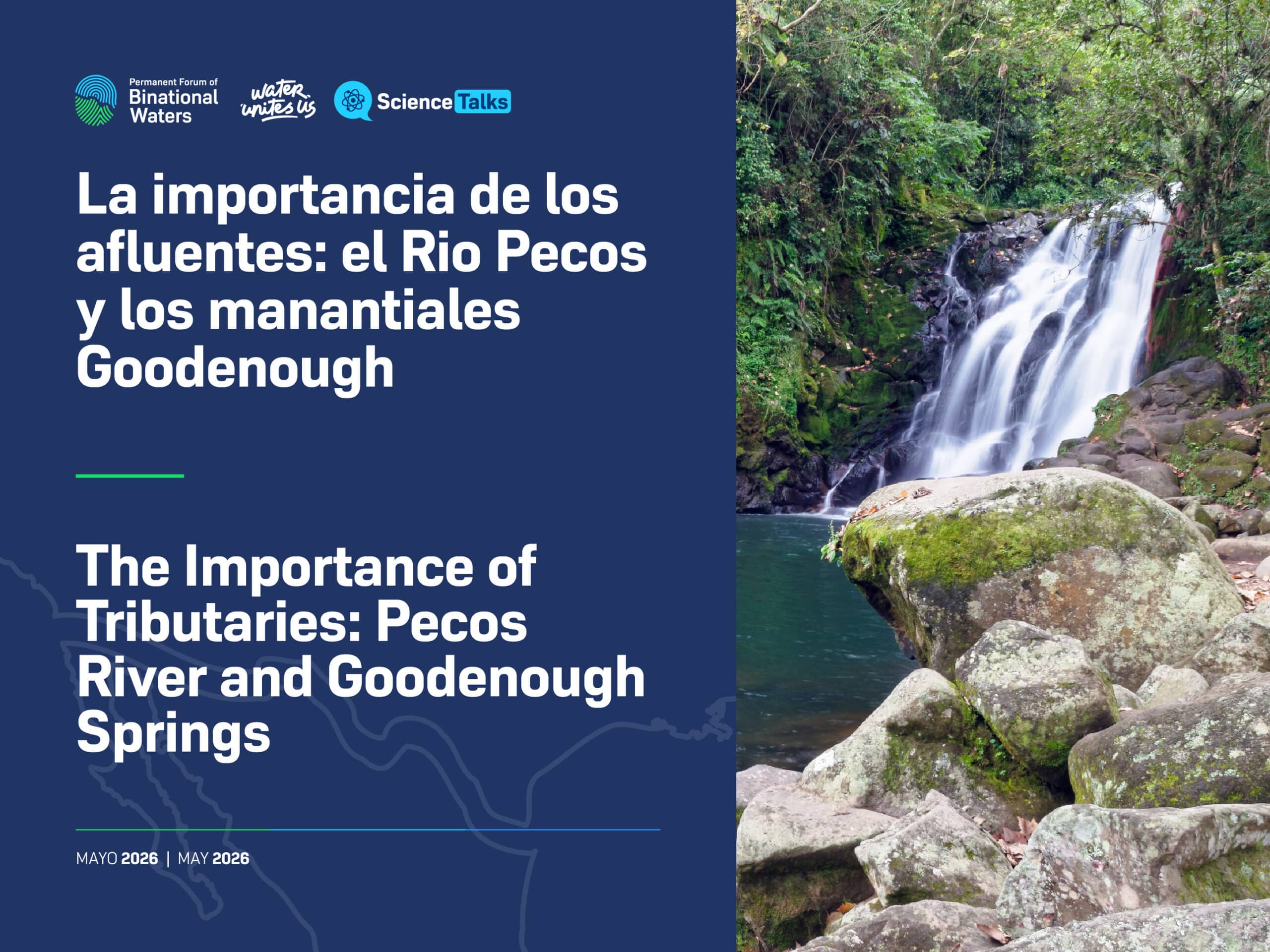
The Pecos River is one of the most important tributaries of the Rio Grande/Bravo Basin and plays a critical role in regional water availability, ecosystem health, and binational water management. Although often discussed in the context of surface water deliveries, recent research highlights the need to better understand how tributaries, groundwater, and spring systems interact to shape water availability across the basin.
To support knowledge sharing on this topic, the Permanent Forum of Binational Waters (PFBW) prepared an event brief based on the Science Talk The Importance of Tributaries: Pecos River and Goodenough Springs, held on March 19, 2026. The document synthesizes the principal findings presented by hydrologists Ramon Saiz-Rodriguez, Ronald Green, and Mauricio Flores regarding hydrological processes and emerging research within the basin.
One of the most significant findings discussed in the brief concerns the historical flow estimates of the Pecos River. Research presented during the event suggests that the river’s contribution may have been substantially overestimated during negotiations of the 1944 Water Treaty. By reconstructing natural and regulated flow conditions, researchers found evidence that historical estimates may differ by approximately 40 percent, with human activities such as reservoir operations, agricultural diversions, and groundwater overdraft contributing to long-term reductions in river flow.
The brief also examines the relationship between surface water, groundwater, and springs. Recent field investigations along the lower Pecos River and the Forgotten Reach seek to identify the sources and processes influencing water chemistry and flow patterns. These studies are helping researchers better understand how tributaries, evaporative processes, and human activities interact across the watershed.
Another important section focuses on Goodenough Springs, historically one of the largest springs in Texas. Geochemical and isotopic analyses suggest that although the spring discharges within the United States, much of its recharge may originate in Mexico, highlighting the interconnected nature of groundwater systems that cross political boundaries. These findings reinforce the importance of considering groundwater and spring systems alongside rivers when evaluating shared water resources.
The event concludes that improving scientific understanding of the Pecos River, its tributaries, and associated groundwater systems is essential for informed binational water management. Readers are invited to consult or download the complete PDF prepared by the PFBW to explore the full synthesis and its implications for future water governance in the Rio Grande/Bravo Basin.


Responses