
 Downstream donation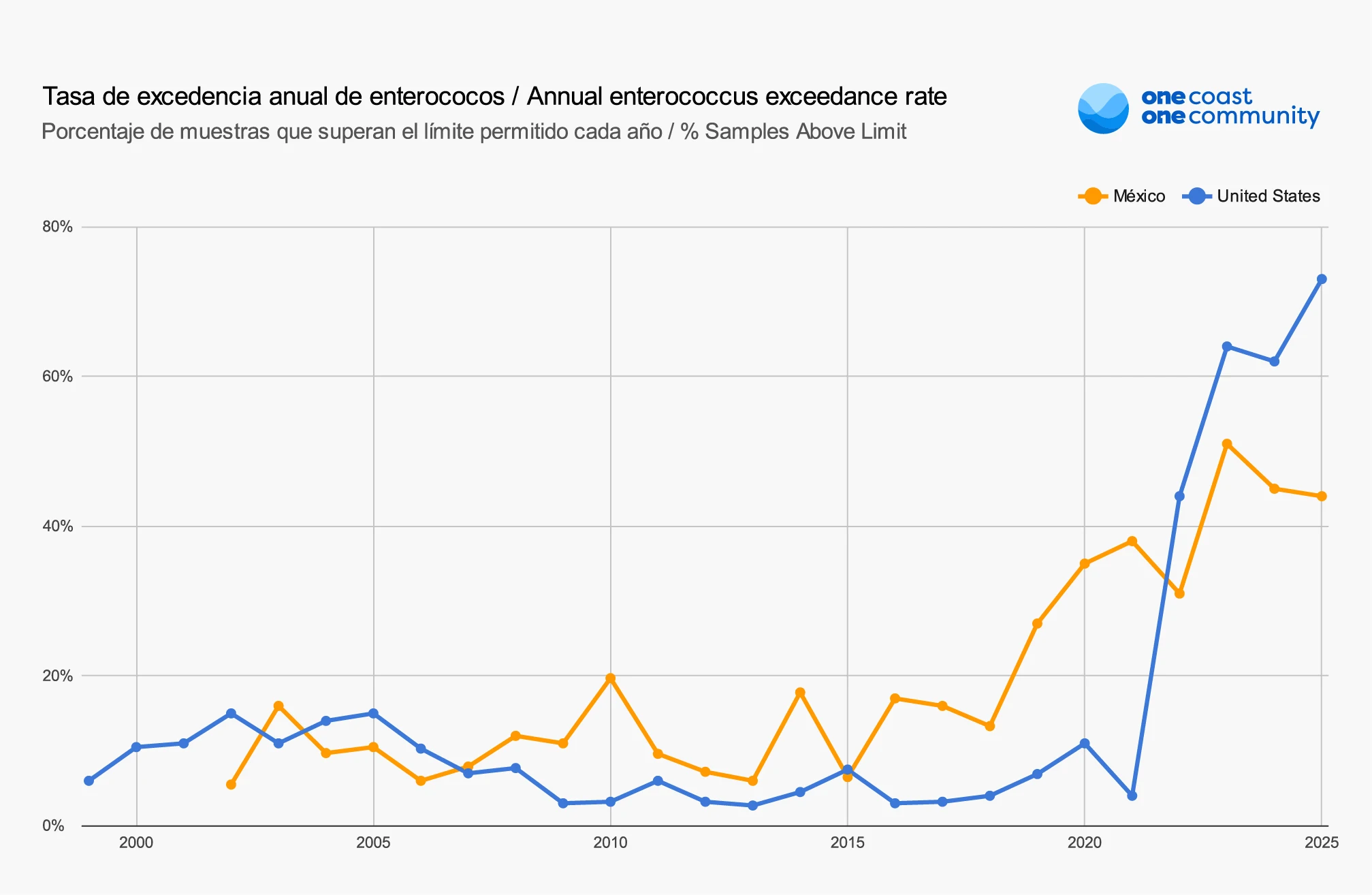
- The study is set to be released soon, with additional information being integrated to maximize its usefulness to the public.
A binational analysis of 25 years of data from 20 beaches, stretching from Carlsbad, U.S., to Rosarito, Mexico, shows that fecal bacteria exceed health standards year-round. However, winter and spring are the most critical seasons, with levels in some cases reaching up to 100 times the recommended limit.
The study, carried out by the Permanent Forum of Binational Waters, found that in Southern California’s Pacific beaches, during Spring, the highest concentrations of enterococci are reported, averaging over 15,000 units per 100 milliliters (ml) of water. This is nearly 100 times the binational legal limit average (152 units per 100 ml, the result of averaging the U.S. limit of 104 and Mexico’s limit of 200).
In Mexico, the picture is also concerning. During the Winter, beaches in Tijuana and Rosarito record an average of 1,116 enterococci per 100 ml—7.3 times the average of the legal limits of both countries. Enterococci are bacteria that appear when there is fecal contamination in our waters and can cause gastrointestinal, skin, and urinary tract infections.
The research reveals that from 1999 to 2017, beaches in Mexico and the United States registered few cases exceeding enterococcus limits. But since 2018 in Mexico and 2020 in the United States, contamination has risen sharply. In 2025, record levels were reached: nearly half of the samples from Mexican beaches and three out of four from U.S. beaches exceeded allowable enterococcus limits.
In the worst years since 1999, no beach from Carlsbad to Rosarito has had more than 40 safe days for recreational use, highlighting the ongoing Carlsbad fecal bacteria issue as part of a broader coastal contamination crisis.
The analysis also found that in Tijuana and Rosarito beaches, winter brings the highest levels of total coliforms, averaging close to 4,000 units per 100 ml. While this is below Mexico’s limit of 10,000 units, it is four times higher than the U.S. limit of 1,000 units. Total coliforms—bacteria associated with fecal contamination—can cause urinary tract, bloodstream, and respiratory infections, gastroenteritis, and meningitis. Their presence is often due to failures in sewage systems or urban and agricultural runoff.
The research shows that in the most critical years on both sides of the border, coastal water quality fails to meet health standards for more than 325 days a year, leaving just 40 safe days for recreational use.
These findings come from data reported by the interactive dashboard developed as part of the One Coast, One Community initiative, the only binational platform that compiles official data on water quality from both countries.
The initiative will be presented in Tijuana on September 4 during the event “Shared Waters and Responsible Economic Development: Data, Talent, and Competitiveness,” in collaboration with CETYS University.
The free platform allows online analysis and data downloads, integrating 25 years of water quality data from the California Water Board, which publishes data weekly, and the Tijuana State Public Utilities Commission (CESPT), which updates data on average once a month.
One Coast, One Community is an initiative of the Permanent Forum of Binational Waters with funding from the San Diego Foundation. Its goal is to foster scientific collaboration, citizen participation, public awareness, and climate resilience in the border region.
Project partners include the San Diego Foundation, the UC Davis Water Management Lab, the California Institute for Water Resources, CETYS University, the Faculty of Engineering and Technology (FCITEC) of the Autonomous University of Baja California, the UNAM Institute of Geography, the International Laboratory for Technology (iSTAR), and the San Diego Regional Chamber of Commerce, all contributing analysis, education, technology, and binational coordination to strengthen coastal resilience.

Responses